Electric winches are no longer limited to off-road recreation. They are used in vehicle recovery, trailers, marine operations, workshops, construction, utilities, agriculture, and industrial positioning. Across these markets, the objective is the same: apply controlled pulling force where manual effort is insufficient and larger machinery is unavailable or inefficient.
The growth of mobile work has increased the value of compact winch systems. Service vehicles, maintenance crews, contractors, and logistics operators often need equipment that can be installed on a vehicle or fixed structure and operated quickly. Wireless controls, automatic brakes, overload protection, and improved motor and gearbox designs have made modern electric winches more practical for professional users.
However, a winch must be selected for the direction and nature of the load. Pulling a vehicle along the ground is not the same as lifting a load vertically. Capacity claims, drum layers, rope angle, duty cycle, anchoring, and braking requirements must all be evaluated. Buyers should never assume that a pulling winch is approved for suspended lifting unless the manufacturer explicitly specifies that use.
Winch capacity is often stated as maximum line pull on the first layer of rope. As more rope builds on the drum, the effective pulling force decreases because the drum diameter increases. A buyer should therefore consider the length of the pull, the amount of rope on the drum, slope, rolling resistance, surface condition, and any mechanical advantage created by a snatch block.
Vehicle recovery requires an additional safety margin because mud, sand, gradients, and damaged wheels can greatly increase resistance. Industrial positioning may involve smoother surfaces but can require more precise speed control and anchoring. Marine use adds corrosion exposure, while construction sites introduce dust, impact, and irregular loads.
Juying’s Electric Winch range includes vehicle-oriented models and other powered pulling solutions. The category offers different line-pull ratings, voltage options, wire-rope configurations, and control methods. Buyers should use the product range as a basis for technical discussion rather than choosing only by the largest advertised number.

The 6000lb and 12000lb Electric Winch with Wireless Remote Control is presented for automotive recovery and related pulling work. Wireless control can allow the operator to stand in a safer viewing position, although safe distance, line-of-pull hazards, and manual override procedures must still be addressed.
Juying also lists a 3500lb Electric Car Winch with steel wire rope, 12V or 24V options, wireless remote control, overload protection, and CE certification. This type of compact winch can suit ATVs, UTVs, light towing, trailers, and utility vehicles when the required pull falls within the model’s rated performance.
For heavier industrial work, the company’s broader product portfolio includes electric winches with clutch systems and models designed for workshops or production equipment. These applications may require floor mounting, adjustable speed, customized drum dimensions, and controls tailored to the process. A vehicle winch and an industrial winch can look similar in principle but differ significantly in duty and safety design.
Vehicle recovery is the most visible application. A winch can help move a stuck SUV, truck, ATV, or utility vehicle toward a secure anchor point. The operator must assess the recovery path, vehicle weight, resistance, anchor strength, rope condition, and bystander position. Recovery dampers, rated shackles, suitable straps, and correct connection points are part of the system.
Trailers use winches to load boats, equipment, vehicles, and machinery. The winch should be aligned with the load to avoid poor rope spooling and side forces. Marine users need corrosion-resistant components and regular cleaning, particularly after saltwater exposure. A winch used for boat loading should be matched to trailer geometry and vessel weight.
Construction and utility contractors use powered winches to pull cables, position materials, move equipment, and support temporary handling tasks. Industrial plants may use winches for die changes, maintenance, or moving components along guided paths. Agriculture uses include loading machinery, tensioning, and recovering vehicles in fields. In every case, the anchor and mounting structure must be engineered for the expected force.
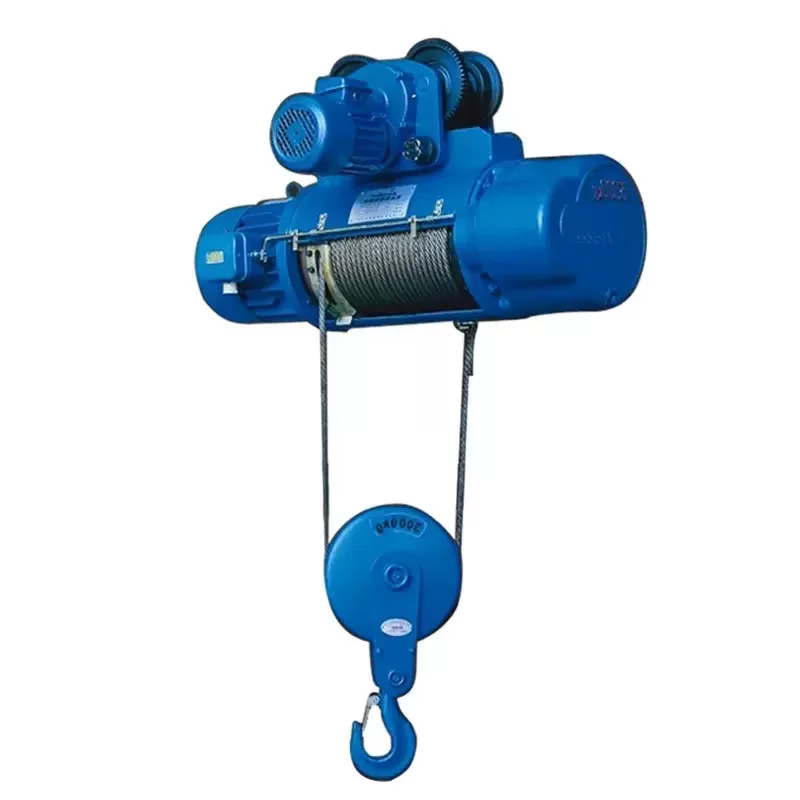
Warehouses and logistics yards can use winches for controlled pulling where forklifts have limited access. Care is needed to prevent sudden movement and to maintain a clear line of sight. When a load must be raised rather than pulled, the buyer should select equipment specifically designed and certified for lifting, such as an appropriate electric hoist.
Electric Winch Wire Rope, Synthetic Rope, Controls, and Braking
Steel wire rope offers abrasion resistance and familiar handling, but it can develop broken wires, kinks, crushing, and corrosion. Operators should wear gloves and inspect the rope before use. Synthetic rope is lighter and stores less kinetic energy, but it can be vulnerable to heat, abrasion, contamination, and ultraviolet exposure. The choice depends on the application and maintenance capability.
Controls can include wired pendants, handheld remotes, wireless transmitters, and vehicle-mounted switches. Wireless operation improves flexibility but requires battery checks, signal reliability, and a safe fallback method. The operator should always maintain visual control of the load path and stop if communication or visibility is lost.
Braking prevents uncontrolled drum movement and helps hold tension. Gear design, automatic braking, clutch mechanisms, and motor protection influence both safety and service life. Buyers should ask how the winch is rated for intermittent or continuous use, because a recovery winch may overheat if used for long industrial cycles without adequate cooling.
Correct spooling is essential. Rope should wind evenly under suitable tension, and the recommended minimum number of wraps should remain on the drum. Side pulling can cause bunching, damage the rope, and place uneven loads on the drum and mounting. Fairleads, rollers, and alignment should be selected for the rope type and installation.
Hebei Juying Hoisting Machinery Co., Ltd. states that it was established in 2005 and operates the GSTOYO brand. The company lists more than 20 years of field experience, over 150 employees, approximately 40,000 square meters of land area, and more than 100 production lines. Its portfolio extends beyond winches to electric hoists, manual chain blocks, lifting chains, slings, pallet trucks, and other handling equipment.
Juying also lists ISO9001, CE, GS, and TUV certifications. International buyers should verify the certifications, test records, and standards applicable to the exact winch model and destination. They should also request installation instructions, wiring information, duty guidance, maintenance procedures, and spare-parts support.
A broad manufacturing base can support distributors that need multiple winch sizes or complementary lifting products. It may also help with customized voltage, rope length, controls, packaging, labels, and branding. Clear technical communication remains essential, especially when an inquiry uses the words lifting, pulling, towing, and recovery interchangeably.
The inquiry should describe the object being moved, its weight, the surface, slope, pulling distance, available anchor, power supply, expected frequency, and environmental exposure. Vehicle users should state battery voltage and mounting location. Industrial users should provide drawings and explain whether the winch will pull horizontally, on an incline, or in another controlled direction.
The supplier should confirm rated line pull, rope length and diameter, drum capacity, gearbox, braking, motor duty, control method, mounting dimensions, and protection level. Buyers should ask how capacity changes across drum layers and whether the model is approved for any vertical lifting. Assumptions at this stage can create serious safety risks later.
During operation, people must stay clear of the tensioned rope and potential recoil zone. The anchor, shackles, straps, and mounting bolts must be rated. The rope should be kept as straight as possible, and the operator should avoid shock loading. After use, the system should be inspected, cleaned, and respoolled correctly.
For vehicle recovery, trailer loading, marine work, or industrial pulling, a properly selected electric winch can reduce labor and improve control. Buyers can review Juying’s available models and discuss line pull, voltage, rope, duty cycle, controls, and customization. The goal is a complete pulling system whose capacity, anchoring, accessories, and operating procedure work together safely.