Industrial production is moving toward shorter lead times, more flexible layouts, and stricter safety control. These changes are visible across Southeast Asia, where machinery manufacturing, automotive supply, metal fabrication, construction materials, and logistics continue to invest in more efficient movement of components. Events such as the 2025 Manufacturing Indonesia Exhibition bring these priorities together: buyers are not only comparing lifting capacity, but also asking how equipment fits existing workshops, how quickly it can be maintained, and how reliably it performs during repeated daily cycles.
In this environment, the electric hoist has become an important link between manual handling and large crane systems. A well-selected unit can reduce physical strain, improve positioning accuracy, and help a workshop use overhead space more effectively. For many international buyers, the most valuable solution is not simply the largest hoist. It is the hoist that matches the load, lifting height, power supply, duty cycle, runway structure, and operating conditions of the facility.
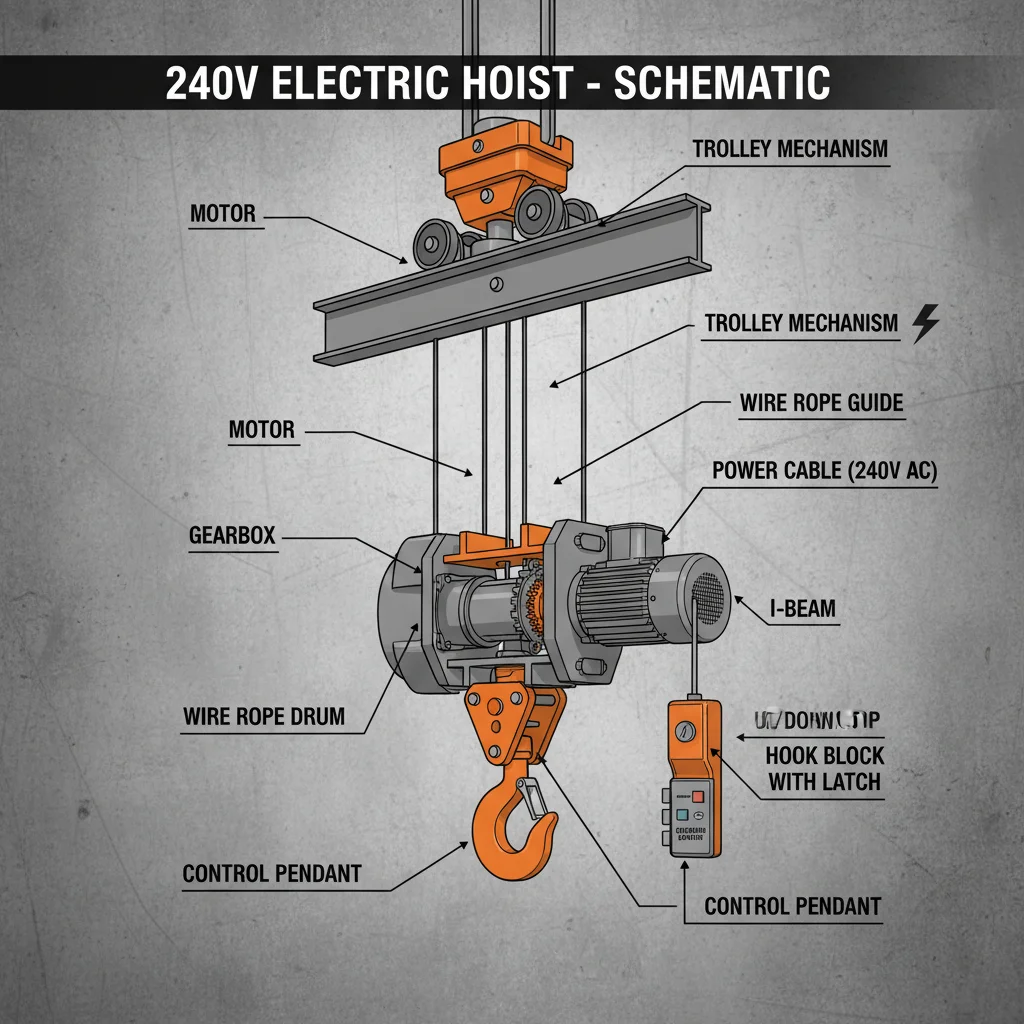
Electric wire rope hoists are especially relevant when buyers need stable vertical movement, longer lifting heights, and efficient travel on monorails or overhead crane beams. Their combination of a motor, drum, steel wire rope, braking system, and control components makes them suitable for demanding industrial applications. At the same time, modern compact designs allow factories with limited headroom to gain more usable hook height without rebuilding the entire workshop.

The main advantage of a wire rope electric hoist is its ability to combine lifting power with controlled movement. In a production line, loads often need to be raised, lowered, and positioned repeatedly rather than lifted only once. Motors and braking systems support consistent handling, while trolley configurations allow the load to move along a beam. This can improve the flow of dies, machine parts, steel assemblies, molds, maintenance tools, and packaged materials.
Wire rope also performs well where lifting height matters. Because the rope is wound on a drum, the system can be configured for workshop bays, warehouses, construction support, equipment installation, and other operations that require a longer vertical travel distance. Buyers can choose between compact mini units for light-duty work and larger industrial models for bridge cranes and heavy production areas.
The Wire Rope Electric Hoist range from Juying includes options for different installation conditions. The range covers compact portable designs, PA mini models, CD1 wire rope hoists, low-headroom European-type units, and specialized winch-style solutions. This variety matters to distributors and engineering contractors because it supports both standard orders and application-specific projects.
A procurement decision should start with the actual task. Rated capacity must exceed the expected working load with an appropriate safety margin, but capacity alone is not enough. Buyers should also confirm lifting height, lifting speed, travel speed, duty classification, ambient temperature, humidity, dust exposure, voltage, frequency, and the dimensions of the supporting beam. A mismatch in any of these areas can reduce service life or create unnecessary installation work.
Low-headroom factories should pay particular attention to the distance between the beam and the hook. A compact configuration can increase usable lifting height and allow tall machinery or assemblies to be handled in an existing building. For larger plants, variable-frequency travel and dual-speed lifting can improve positioning control. For smaller workshops, a single-phase mini electric hoist may be more practical because it can operate from commonly available power supplies.
Juying’s Low-Headroom European-Type Wire Rope Hoist is presented for single-girder overhead crane applications and is described with FEM and CE compliance, compact clearance, dual-speed lifting, inverter trolley travel, overload protection, and limit switches. For lighter work, PA-Series Mini Electric Hoists focus on compact installation and standard 110V or 220V power. These different product directions show why buyers should compare configuration rather than treating every electric hoist as interchangeable.
In machinery manufacturing, wire rope hoists help move motors, gearboxes, frames, tools, and partially assembled equipment between workstations. Controlled lifting is valuable when a component must be aligned with a machine bed or positioned for bolting. In metal fabrication, hoists can support plate handling, welding preparation, and movement of structural parts, reducing the need for repeated forklift intervention.
Warehouses and logistics centers use electric hoists for loading support, maintenance, and handling heavy items that do not fit standard pallet workflows. Construction contractors may use compact models for raising tools and materials in controlled areas, while larger systems support prefabrication yards and building-material plants. In maintenance departments, a hoist can be used for removing pumps, motors, valves, and machine covers without tying up a mobile crane.
Shipyards, energy projects, and heavy industrial plants often require longer lifting heights and robust components. Here, the selection process should include corrosion protection, duty cycle, brake design, rope specification, and access for inspection. The ability to customize voltage, lifting height, control method, and trolley arrangement is therefore important for international projects where local standards and site conditions differ.
Product specifications must be supported by manufacturing capability. Hebei Juying Hoisting Machinery Co., Ltd. states that it was established in 2005 and operates the GSTOYO brand. The company presents more than 20 years of industry experience, over 150 employees, approximately 40,000 square meters of land area, and more than 100 production lines. These figures indicate a production base designed to serve multiple lifting-equipment categories rather than a single narrow product.
The company also lists ISO9001, CE, GS, and TUV certifications. For overseas distributors and project buyers, certification is valuable because it supports technical documentation, quality-control discussions, and market-entry requirements. However, buyers should still confirm the exact certificate and standard applicable to the selected model, destination country, and intended use.
Participation in the 2025 Manufacturing Indonesia Exhibition also supports direct communication with regional customers. Trade exhibitions allow buyers to compare product structure, discuss voltage and capacity requirements, and evaluate whether a supplier can provide catalogs, samples, spare parts, and customization. They also help manufacturers understand local expectations for delivery, documentation, and after-sales support.
Before placing an order, buyers should provide a clear application sheet. It should include the maximum load, normal working load, lifting height, beam size, required horizontal travel, daily operating frequency, power supply, control preference, and installation environment. Photos or drawings of the site can help the supplier recommend a suitable configuration and reduce revisions later.
Safety features should be reviewed as a complete system. Important items include upper and lower limit switches, overload protection, emergency stop functions, brake design, hook safety latches, motor protection, and control voltage. The supporting beam, trolley, electrical connection, and installation method must also be suitable for the rated load. A reliable hoist cannot compensate for an inadequate support structure.
Maintenance planning should be discussed before shipment. Wire rope condition, drum winding, brake wear, lubrication, fasteners, electrical connections, and limit switches all require inspection. Buyers should ask for manuals, spare-parts lists, recommended inspection intervals, and technical support procedures. Distributors may also benefit from stocking commonly replaced components so end users can minimize downtime.
Finally, the lowest purchase price should not be the only comparison point. Total operating value includes installation compatibility, energy use, durability, availability of parts, packaging, delivery reliability, and the supplier’s ability to respond when an application changes. A carefully matched electric wire rope hoist can remain productive for years, while an unsuitable unit may create repeated costs even if its initial price is attractive.
Juying positions itself as a global supplier of hoists, slings, winches, magnetic lifters, and related material-handling products. This broader portfolio can be useful for distributors and industrial buyers who want to consolidate purchasing across several categories. It also allows a project to combine an electric hoist with compatible lifting accessories and handling tools from one source.
For factories planning an upgrade, the most effective next step is to define the lifting task in measurable terms and review the available configuration with an experienced supplier. International buyers can explore Juying’s product range, request technical documents, and discuss capacity, lifting height, voltage, controls, and installation requirements. The objective is not simply to buy a machine, but to create a lifting system that improves safety, workflow, and long-term productivity.